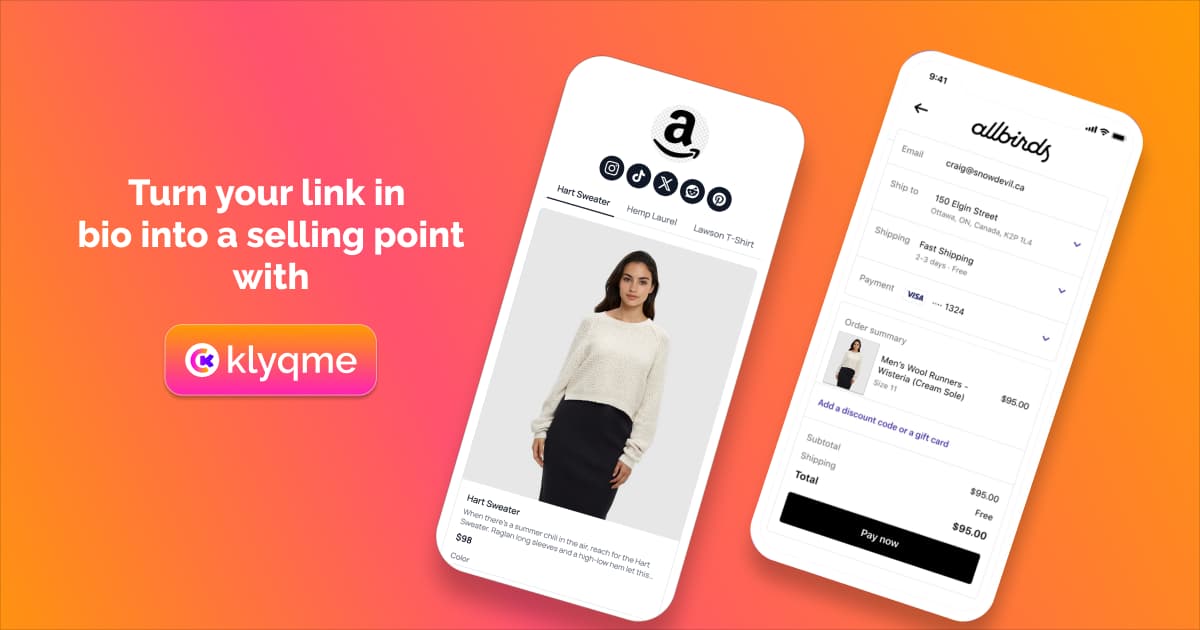
Yes, you can sell products from a link-in-bio page without sending every visitor to your store homepage. With Klyqme, a Shopify merchant can display live product information and send the selected variant to Shopify checkout. A creator can also sell a digital file directly through a connected Stripe account and deliver the download automatically after payment.
Those are two different purchase paths. Choosing the right one depends on whether Shopify or Klyqme manages the product.
| What you sell | Product source | Where the buyer pays | What happens after payment |
|---|---|---|---|
| Shopify product | Your connected Shopify store | Shopify checkout | Shopify manages the order, stock, tax, shipping, and fulfillment |
| Digital product | A product created in Klyqme | Hosted Stripe Checkout connected to your Stripe account | Klyqme provides the purchased file through the delivery flow |
| Native physical product | Not currently part of the Klyqme commerce launch | Not applicable | Use a Shopify product block instead |
Why a product-specific bio page is different from a list of links
A traditional bio page sends visitors to destinations: a homepage, a collection, a newsletter, or a social profile. A commerce bio page can show the product that motivated the visit before the shopper leaves the page.
That distinction matters on mobile. Someone arriving from a product video should not need to rediscover the item inside a large catalog. The page can present its image, name, price, options, and purchase action immediately, while still leaving checkout and order management to the appropriate commerce system.
Klyqme currently keeps the buying model intentionally simple: one product purchase path at a time. It is not a multi-product replacement cart.
Path 1: sell a Shopify product from your bio
Use this path when the product already exists in Shopify and Shopify should remain the source of truth.
What Klyqme reads from Shopify
After a merchant connects a Shopify store and supplies a supported product URL, the Shopify product block can use the product information returned by the store, including:
- product name and description;
- product images;
- current price and currency;
- option names such as Size, Color, Material, or Style;
- available option values;
- variant availability and stock state.
The labels are important. A shopper should see “Size: M” or “Color: Black,” not an unexplained list of values. When more than one option exists, the selected values are resolved to a Shopify variant.
What happens when the shopper selects Buy
The shopper chooses the available options on the Klyqme page. Klyqme then opens the Shopify purchase path with the selected variant. Shopify performs the definitive inventory check and owns checkout, payment, taxes, shipping, the order, and fulfillment.
Shopify documents this underlying pattern as a cart permalink: a link can pre-load specific product variants and quantities before sending a customer into the store’s checkout flow [1].
Klyqme does not copy the Shopify product into a separate inventory system and does not process that Shopify payment through the merchant’s Klyqme-connected Stripe account.
Why keep Shopify as the source of truth
Product data changes. Prices are updated, a size sells out, or an image is replaced. Reading the product from Shopify avoids maintaining two independent versions of the same catalog.
It also preserves the operational workflow the merchant already uses. Shopify states that product inventory is checked when a customer reaches checkout [2]. The merchant therefore continues to manage stock and orders in Shopify rather than reconciling them with a second commerce backend.
Shopify setup checklist
- Connect the Shopify store in Klyqme integrations.
- Add a Shopify Product block to the bio page.
- Paste the product URL from the connected store.
- Confirm the name, price, images, option labels, and availability returned by Shopify.
- Choose the block layout that fits the page.
- Test every option combination that will be promoted.
- Confirm that Buy opens the Shopify checkout path with the chosen variant.
- Publish and test again from a real mobile browser.
For merchants replacing Shopify’s discontinued Linkpop experience, read the Linkpop alternatives guide and the Linkpop migration checklist.
Path 2: sell a digital product with Stripe
Use this path for a file that Klyqme will sell and deliver, such as an ebook, template, preset, guide, audio file, or downloadable resource.
What the seller configures
The seller creates a Digital Product block and provides:
- a product name;
- a description;
- a cover image;
- the downloadable file;
- a price;
- a supported currency;
- an optional post-purchase message.
The currency selected for the product is sent into the Stripe Checkout flow. The product is not locked to CAD; the seller chooses the relevant supported currency when configuring it.
How payment works
The seller connects a Stripe account to Klyqme. When a buyer selects the purchase button, Klyqme creates a hosted Stripe Checkout session using the product’s price and currency. Stripe hosts the payment page and processes the payment for the connected seller.
This is direct selling through Klyqme, but it is not an inline card form embedded inside the public bio page. Stripe describes Checkout as a prebuilt payment form that can be hosted by Stripe [3]. That hosted flow is the current Klyqme implementation.
How delivery works
After a successful purchase, the buyer receives access to the digital product through Klyqme’s delivery flow. The download link is generated for the purchased file rather than exposing the original media-library file as a public product URL.
Before publishing, test the complete non-payment setup and verify that:
- the correct product appears in Stripe Checkout;
- the price and currency match the block;
- the success flow identifies the correct order;
- the delivery page or message references the correct file;
- the download link opens the purchased file.
Payment processors can apply their own processing fees, and those fees vary by account and country. Consult the connected Stripe account for its applicable pricing.
Digital product setup checklist
- Connect the seller’s Stripe account.
- Add a Digital Product block.
- Save the block so it has a persistent product identity.
- Add the image and downloadable file.
- Set the price and currency.
- Choose the card, banner, or compact presentation.
- Review the post-purchase content.
- Open the hosted checkout and validate the product details without completing a real payment.
- Publish the page.
Current Klyqme pricing and commerce fees
Klyqme’s current monthly plans are:
| Plan | Monthly price | Klyqme fee on native digital-product sales |
|---|---|---|
| Free | $0 | 5% |
| Core | $9.99 | 2% |
| Growth | $29.99 | 0% |
Annual billing receives the discount shown on the pricing page. Stripe processing fees are separate from Klyqme’s platform fee.
The table above applies to native sales handled through the Klyqme digital-product and Stripe flow. A Shopify product block sends the customer to Shopify checkout; Shopify and the merchant’s payment setup govern that transaction.
How to design a product block for mobile shoppers
The commerce logic can be correct and still perform poorly if the block hides the information a buyer needs.
Let the product image use the available width
Avoid placing a small product thumbnail in a large empty frame. Preserve the image’s useful aspect ratio and let it occupy the width of the product surface. If a crop is required by a selected layout, keep the important part of the product visible and review it at the actual mobile width.
Keep product information legible
The product name, price, option labels, availability, and main action should not look like secondary metadata. They are the core decision surface. Use the page’s typography and color theme while maintaining clear hierarchy and touch targets.
Use option labels, not only values
“M” is ambiguous. “Size: M” is understandable. “Aqua / Yellow” becomes useful when it is introduced by “Color.” Shopify option names should therefore remain visible whenever the product provides them.
Match the action to the actual outcome
Use “Buy” or “Buy now” when the button opens a purchase flow. Avoid “Shop” for a single-product direct checkout action, because it suggests browsing a store rather than purchasing the displayed item.
Keep the page focused
One featured product, a small number of supporting products, useful answers, and one primary action are generally easier to understand than a complete catalog compressed into a narrow bio page. Link to the full store when the visitor wants to browse everything.
Tracking Shopify and digital-product traffic
Use a separate Klyqme page or page variation for each acquisition context when you need clean attribution. An Instagram product demonstration, a TikTok campaign, and a newsletter can each point to a tailored page while preserving the same brand and product source.
At minimum, track:
- visits to the public page;
- clicks on the product action;
- the page or variation that generated the click;
- campaign parameters carried into supported outbound links;
- checkout creation for native digital products;
- successful orders and file delivery for native digital products.
Pixels and analytics require visitor consent where applicable. Klyqme’s consent layer prevents configured retargeting pixels from firing before consent. See the retargeting pixel guide for implementation details.
Once traffic is meaningful, compare one change at a time with bio-page A/B testing: product layout, headline, supporting proof, or call to action.
Frequently asked questions
Can I sell Shopify products from my link in bio?
Yes. Connect Shopify, add a Shopify Product block, and paste a product URL. Klyqme displays the product information and options returned by Shopify. After the shopper selects an available variant, the purchase action opens the Shopify checkout path. Shopify remains responsible for payment, inventory, tax, shipping, orders, and fulfillment.
Does Klyqme process the payment for a Shopify product?
No. A Shopify Product block redirects the buyer into Shopify’s checkout flow. The merchant’s Shopify payment configuration processes that transaction. The Stripe account connected directly to Klyqme is used for Klyqme’s native commerce flows, such as digital products, not for the redirected Shopify order.
Can I sell a digital product without Shopify?
Yes. Create a Digital Product block, upload the file, set the price and currency, and connect Stripe. The buyer pays through a hosted Stripe Checkout session created for the connected seller. Klyqme then handles access to the purchased download.
Does the buyer receive the digital product automatically?
Yes. A successful digital-product order is associated with the purchased file and gives the buyer a delivery path with a working download link. The seller should still test the product, checkout details, success page, and download before promoting the page.
Is a digital product limited to Canadian dollars?
No. The seller selects a supported currency in the Digital Product block, and Klyqme uses that currency when creating the Stripe Checkout session. The connected Stripe account must be able to accept the selected currency.
Can I sell a physical product directly through Klyqme without Shopify?
Native physical-product fulfillment is not part of the current Klyqme commerce launch. For a physical item, use the Shopify Product block so Shopify manages variants, stock, checkout, shipping, and the order.
Does Klyqme support a multi-product cart?
The current purchase flow is intentionally single-product. A page can display several products, but each product action starts its own purchase path. Use the full Shopify store when the buyer needs to build a multi-product cart.
Do I need a website to sell a digital download?
No. A public Klyqme page, a connected Stripe account, and a configured Digital Product block are enough to create the purchase and delivery flow. A separate ecommerce website is not required.
Start with the product source
The safest way to build a shoppable bio page is to decide which system owns the product before choosing a layout.
- If the product lives in Shopify, let Shopify own its variants, inventory, checkout, and order.
- If the product is a downloadable file created in Klyqme, connect Stripe and use the native digital-product delivery flow.
- If the visitor needs to browse or assemble a large cart, link to the full store rather than forcing the catalog into one bio page.
That separation keeps the buying experience short without creating duplicate prices, stock, orders, or fulfillment rules.